


2025 ended on a negative note for Italian wine worldwide, the victim of an unfavorable global economic situation and a trade storm that severely impacted overseas markets. According to ISTAT data analyzed by the Unione Italiana Vini (UIV) Observatory , Italian exports closed the year at €7.78 billion , a 3.7% decrease compared to 2024. In absolute terms, approximately €300 million was missing, with shipment volumes falling to 21 million hectoliters (-1.9%).
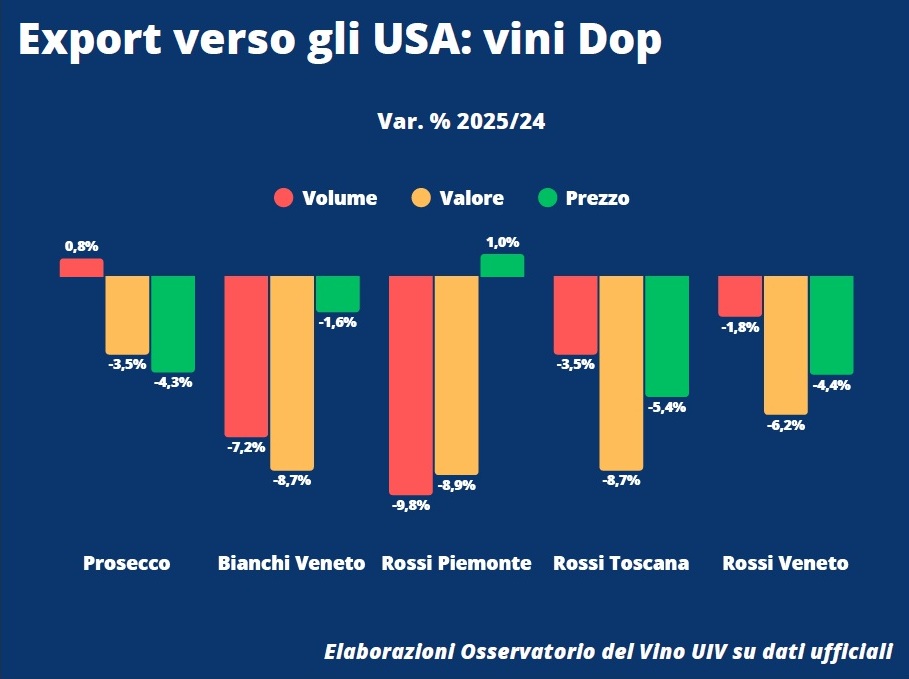
This budget deficit was primarily due to the collapse of the US market . The USA, historically the primary destination for our wines, recorded a significant -9.2% in value , losing €178 million. Performance was impacted by the introduction of customs duties in the second half of the year and the simultaneous devaluation of the dollar , which curbed purchases of still red wines and sparkling wines. While the non-EU area is suffering overall (-6.4%), the strength of the European domestic market (+0.5%) is partially saving the economy, with Germany remaining stable and France, paradoxically, increasing purchases of Italian wine by 3.6%.
The very comparison with our French cousins offers a ambivalent perspective. While Italy mourns, France “despairs”: Paris closed the year with losses double that of Italy (-18.8% in the US). “A Pyrrhic victory,” commented UIV Secretary General Paolo Castelletti , “since we’re gaining market share only because others are losing more.”
From a regional perspective, the three “locomotive” regions of Italian wine are declining: Veneto limited the damage (-1.2%), while Tuscany and Piedmont dropped 2% and 2.2%, respectively. Among the wine types, sparkling wines (-2.5%) confirmed greater resilience compared to still wines, which fell by 4.3%.
For UIV President Lamberto Frescobaldi , the recipe for recovery lies in removing bureaucratic barriers within the European Union and decisive trade diversification. “The ‘wake-up call’ of tariffs requires us to broaden our horizons to new third-party markets,” he declared, emphasizing how managerial activism and synergy with institutions are now essential to defending the primacy of Made in Italy.
Developed from ISTAT sources and the Italian Wine Union Observatory