




by Umberto Gambino
From a peak of 128 liters per capita in the early 20th century to 26 in 2024, wine consumption in Italy and around the world has undergone a profound transformation. Drinkers aren’t disappearing: informed ones are growing.
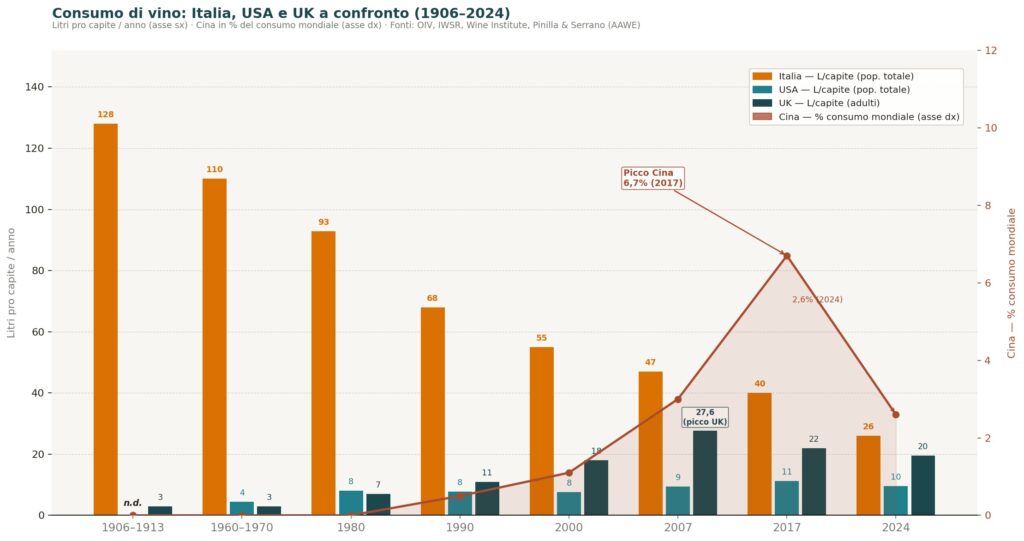
There’s a number that better describes Italians’ relationship with wine than any analysis: 128 liters . That was the average amount consumed annually by each inhabitant of our country between 1906 and 1913. They weren’t all adults, they weren’t all men, they weren’t all lovers of good food. It was simply wine as a daily staple, a constant companion at meals, a source of calories in a country that hadn’t yet reached the heights of prosperity. Today, that figure has dropped to 26 liters per capita , and even if we only consider the population aged fifteen and over —as the International Organization of Vine and Wine (OIV) does—we arrive at 42.7 liters in 2024. A collapse, certainly. But also a transformation.
The downward spiral has had its dramatic accelerations. After a second peak of around 110-115 liters in 1970 , consumption began to slide, but it was in 1986 that one of the darkest episodes in Italian wine history occurred: the methanol scandal . Twenty-three deaths from wine adulterated with industrial alcohol, bottles recalled from shelves, a shattered trust that left a lasting scar on consumption habits. The crisis accelerated a process already underway, and from that moment on, the decline has never stopped. What has profoundly changed, however, is not just quantity: it is also the structure of consumption. According to Istat 2024 data, daily drinkers went from 33.3% in 1999 to 19% in 2023. Over the same period, occasional drinkers have grown from 37.3% to 49.8%. In absolute terms, those who drink wine every day have dropped from about 4 million to 1.3 million over the last twenty years . And 47% of this small group of faithful are over sixty.
Wine and generations
Looking at the current picture of Italian consumption without taking generations into account means missing the most interesting part of the story.
The total 29.4 million consumers in 2024 are far from evenly distributed: 8.1 million are over 65, and occasional consumption—those who raise a glass without it becoming a daily ritual—is dominant, with 17.75 million people out of 26.3 million being regular or occasional consumers. The data from the Nomisma Wine Monitor 2025 outline a clear generational gradient: Baby Boomers drink wine every day in 35% of cases, Generation X in 29%, Millennials in 21%, Generation Z in 10% . Overall penetration—that is, those who drink wine at least occasionally—reaches 62% among those aged 35 to 44, the highest age group. But the most surprising figure is that of young people between 20 and 24: 51% declare they consume wine , a historic record for this age group.
Ecco il paradosso che i produttori di vino stanno imparando a leggere con cautela. La Generazione Z non diserta il vino, anzi: lo avvicina con una curiosità che i loro nonni non avevano, ma lo consuma in modo radicalmente diverso. Non al pasto, ma fuori pasto. Non in quantità, ma in qualità. Non per abitudine, ma per scelta. Secondo un’indagine IWSR pubblicata nel luglio 2025, il 67% della Gen Z e il 61% dei Millennials dichiarano di moderare deliberatamente il proprio consumo di alcol. È una tendenza che attraversa tutto l’Occidente: la sobrietà come postura culturale, non come rinuncia forzata. La Gen Z predilige bollicine e bianchi fruttati, frequenta i bar ma non la cantina di famiglia, e valuta il vino anche attraverso la lente della sostenibilità ambientale. È un consumatore esigente, discontinuo e difficile da fidelizzare.
How consumption is changing around the world
The Italian situation fits into a global trend that the OIV has captured with worrying figures for the sector. Global wine consumption in 2024 stood at 214 million hectoliters, the lowest level since 1961. In 2025, it fell further to 208 million hectoliters , a 2.7% decline in twelve months. From 2018 to today, the cumulative contraction exceeds 14%. Yet wine has become globalized: the study by Anderson and Pinilla of the University of Adelaide highlights that, while global volumes have remained essentially unchanged since 1961, the geography of drinking has radically changed. Countries previously unfamiliar with wine have adopted it, while traditional large consumers have reduced their consumption.
The case of China is emblematic: it rose from 1.1% of global consumption in 2000 to 6.7% in 2017, only to plummet to 2.6% in 2024, a 19.3% decline in the last year alone. The United States, which also saw per capita consumption increase tenfold between 1960 and 2021, from 3.4 to approximately 12 liters, is now showing a first reversal of the trend, reaching 11.8 liters in 2024.
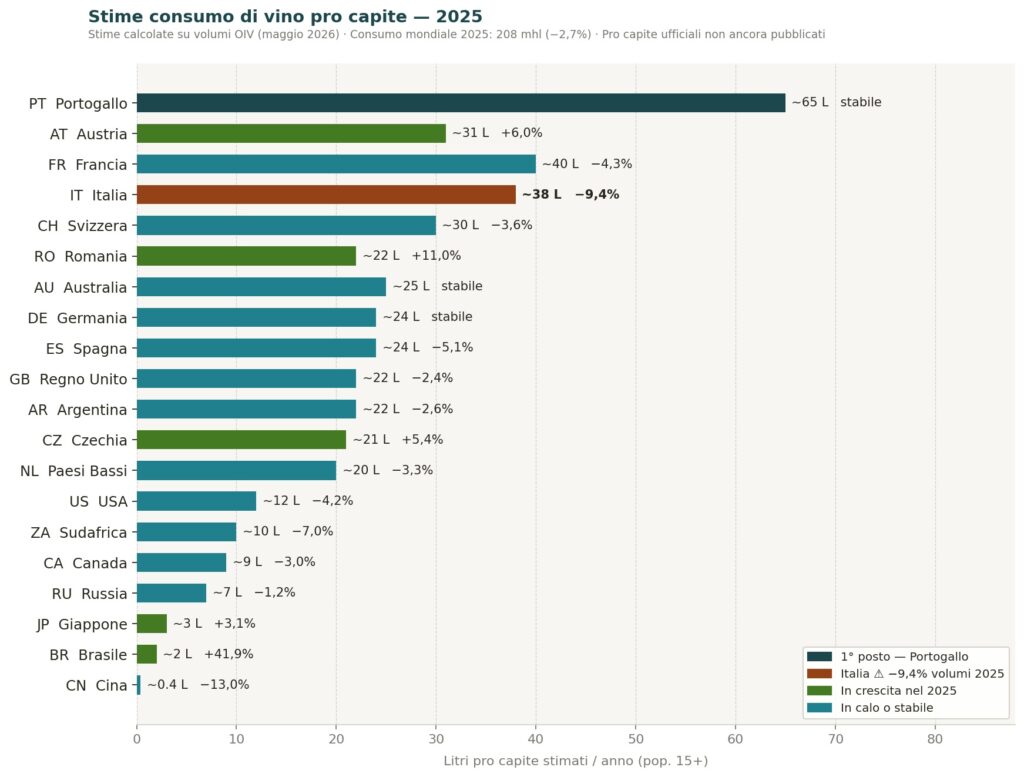
The United Kingdom , which had reached a peak of 27.6 liters per capita (among adults) in 2007, has fallen to 22.3, a 14% decline since the start of the millennium. Portugal, in Europe, is holding its ground: 61.1 liters per capita in 2024, first in the world . France stands at 41.5 liters , but the decline is also steady there, with a -4.3% recorded in 2025. And one of the strongest generational signals comes from France: according to the French Observatory on Drugs and Addictive Tendencies, one in five adolescents—19.4%—has never consumed alcohol, a figure that has tripled in twenty years. Even across the Alps, young people are abstaining.
Cheap wines are falling
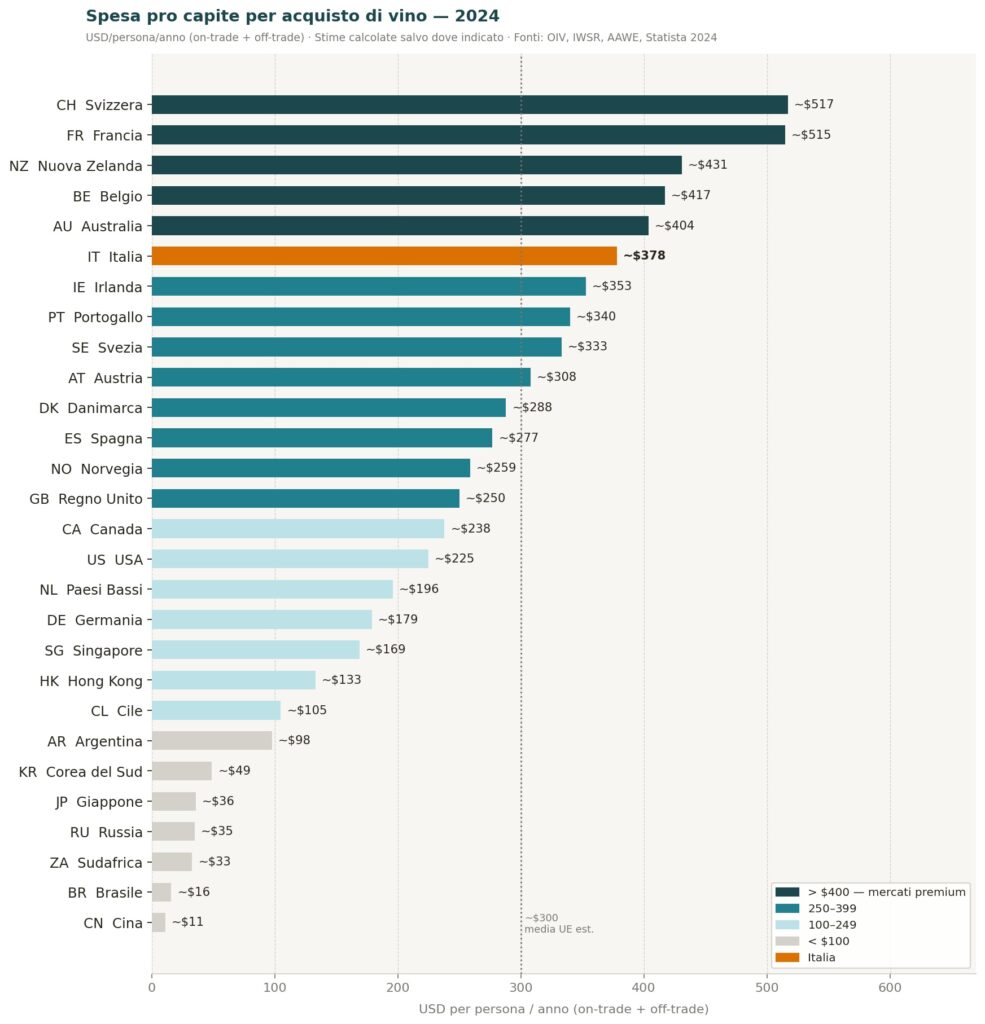
Against this backdrop of declining volumes, the market is redesigning its architecture. Affordable wines, those under $10 a bottle, have been losing ground at a rate of 4% annually over the past five years. Premium wines are declining much less, about 1% annually. The message is clear: those who drink less want to drink better. And in the United States, where Millennials now represent 31% of wine consumers and have surpassed Baby Boomers, this generational shift is felt in purchasing decisions, discovery platforms, and the way wine is discussed on social media. According to IWSR data, the overall number of wine consumers in the world’s major markets decreased by five million between 2021 and 2024. It’s not a collapse. It’s a reconfiguration.
Wine has endured scandals, wars, recessions, and cultural revolutions. It has lost its role as a staple food without losing its allure. The paradox that emerges from the data is that never before has wine been so geographically widespread throughout the world—present in markets that were unfamiliar with it a hundred years ago—and never before has it been consumed more sparingly in the countries that invented it. The decline in volumes isn’t a defeat: rather, it speaks of A drink that has ceased to be routine and is becoming a language. Whoever drinks it, chooses it. Those who don’t drink it will perhaps one day discover it in their own way—with fewer prejudices, more curiosity, and probably with a glass of bubbles in hand.
Sources
Nomisma Wine Monitor 2025 — https://www.nomisma.it/
Istat, Aspects of Daily Life 2024 Survey — https://www.istat.it/
OIV, World Wine Market Report 2024 and 2025 — https://www.oiv.int/
IWSR Drinks Market Analysis, July 2025 — https://www.theiwsr.com/
OFDT — Observatoire Français des Drugs et des Tendances addictives — https://www.ofdt.fr/
Anderson & V. Pinilla, Wine Globalization, University of Adelaide Press — https://www.adelaide.edu.au/