


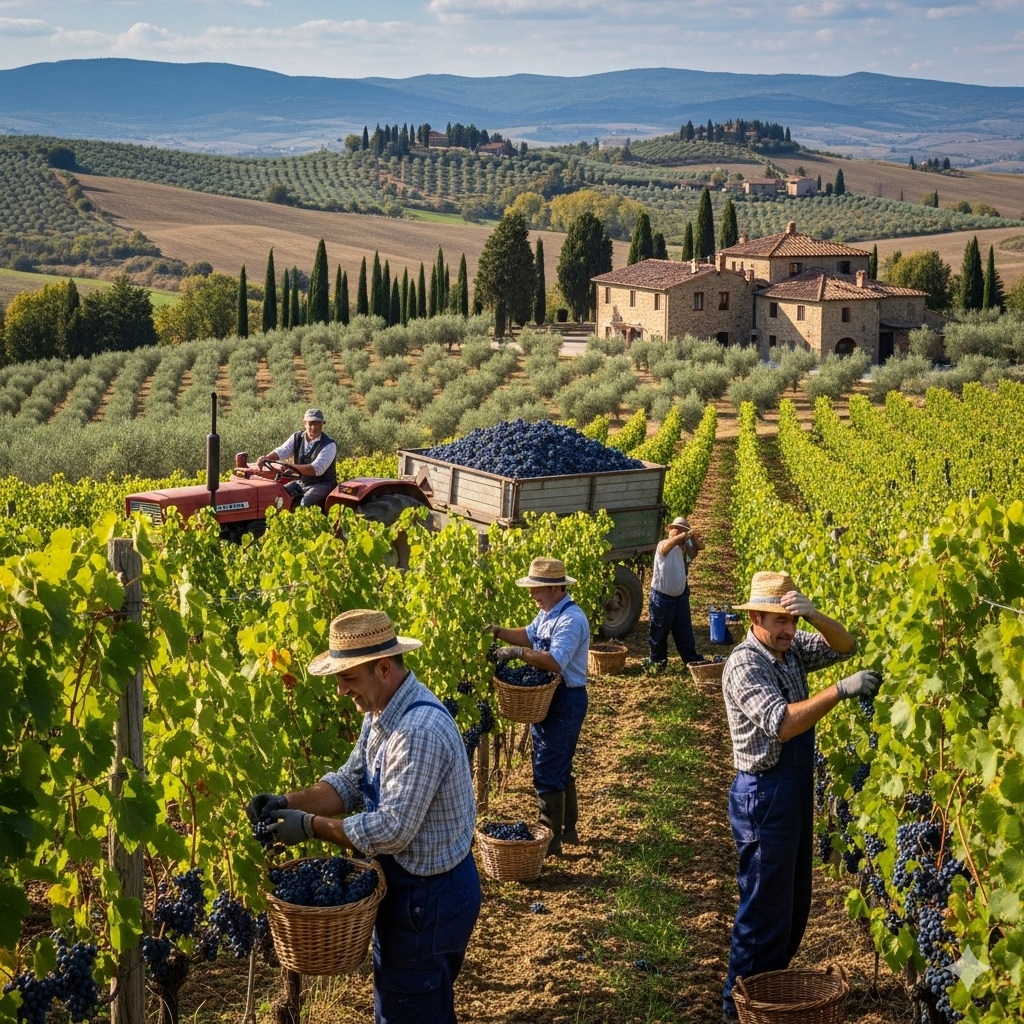
The 2025 harvest is expected to reach 47.4 million hectoliters , with healthy grapes promising a very good to excellent year in almost all areas, with peaks of excellence . This is the finding of the 2025 harvest survey, conducted through a process of harmonizing the methodologies adopted by Assoenologi , Unione italiana vini (UIV), and the Institute of Services for the Agricultural Food Market (ISMEA), with the addition of contributions from the competent Office of the Ministry of Agriculture, Food Sovereignty and Forestry , and the regions. According to the estimates, production is expected to increase by 8% compared to the previous campaign, bringing volumes back in line with the average of recent years after two particularly poor years (+2% over the 2024-2025 average). A harvest that confirms Italy’s production primacy , followed in the global ranking by European competitors France (37.4 million hectolitres) and Spain (36.8 million hectolitres).
While still exposed to the weather conditions of the coming weeks, the grapes are in good health condition , thanks to careful and scientific agronomic management , which is essential in an environment increasingly marked by extreme events. The harvest season was preceded by a period of uncertainty related to the variable summer weather. However, the good water reserves accumulated during the winter, a mild spring, and an early but fluctuating summer have favored an early harvest in many areas, with a distribution of harvest times that promises to be long, especially in Southern Italy. The phenolic maturity achieved in most areas, combined with the aromatic potential favored by the temperature swings in late August, suggests fresh and long-lived wines in the North, clean and balanced profiles in Central Italy, and structured and characterful reds in the South.

According to Assoenologi president Riccardo Cotarella , “The quality of the grapes promises to be very good, even excellent in some areas. This is crucial, because in a complex time like the one we are experiencing, wine quality becomes a decisive factor, even on the market, and requires even greater attention to winemaking. In this contradictory and unpredictable scenario, the role of winemakers is once again confirmed as crucial.”
According to ISMEA Director General, Sergio Marchi : “The 2025 harvest recorded largely positive results in terms of both quantity and quality, with a trend also confirmed by regional estimates and by particularly significant growth in Southern Italy.”
The president of the Italian Wine Union (UIV), Lamberto Frescobaldi , is optimistic: “We toast to an excellent vintage in terms of quality, but not in terms of quantity. Under current market conditions, it will be difficult to guarantee fair compensation to the supply chain with a harvest of 47.4 million hectoliters, to which will likely be added approximately 37 million hectoliters of wine in the cellar. We are faced with challenges that affect not only Italy, but all producing countries.
Regarding the market situation, the president of Agenzia ICE , Matteo Zoppas , also intervened: “ Italian wine is facing a complex phase that is seeing a positive harvest but with a saturated market and penalizing US duties, albeit at the basic rate of 15%”.
The increase in production is unevenly distributed across the peninsula. Growth is undoubtedly driven by the South (though last year saw a decline), where the harvest recorded a double-digit jump (+19%)—driven by Puglia’s performance (+17%)—thanks to the water availability accumulated in the spring, which allowed vineyards in the southern regions to respond well to the heatwaves of June and August. Production is also increasing, albeit at a more modest rate, in the North, with Lombardy in the Northwest (+8%) showing a clear recovery, up 15% over last year but still down 8% compared to the 2020-2024 average. Overall, production in vineyards in the Northeast is also increasing (+3%), where a fluctuating summer was preceded by a very rainy spring, requiring careful disease management. In order, Friuli-Venezia Giulia recorded the largest increase (+10%), followed by Trentino-Alto Adige (+9%) and Veneto (+2%), with very limited growth compared to a 2024 vintage in line with the five-year average. Emilia-Romagna remained stable, divided between increases in Romagna and declines, especially in grape weight, in Emilia. Finally, Central Italy experienced a negative performance (-3%), where the performances of Umbria (+10%), Marche (+18%), and Lazio (+5%) failed to offset the loss of Tuscany (-13%), which was natural after a truly abundant 2024.
In the regional rankings, with nearly 12 million hectoliters and a quarter of the Italian harvest, Veneto remains Italy’s leading producing region, followed by Puglia and Emilia-Romagna , with 19% and 15% respectively, for a total of 59% of national production. Sicily and Abruzzo follow in the top five, pushing Piedmont and Tuscany into sixth and seventh place on the list.
Wine and must production in Italy (thousands of hectoliters) – Estimates
| Media 2020-2024 | 2024 | 2025* | % Change 2025*/2024 | |
| Piedmont | 2,654 | 2,698 | 2,832 | 5% |
| Aosta Valley | 16 | 11 | 12 | 8% |
| Lombardy | 1,231 | 989 | 1.137 | 15% |
| Trentino-Alto Adige | 1,295 | 1.156 | 1,260 | 9% |
| Veneto | 11,768 | 11,699 | 11,992 | 2% |
| Friuli-Venezia Giulia | 1,866 | 1,655 | 1,820 | 10% |
| Liguria | 42 | 41 | 41 | 0% |
| Emilia-Romagna | 7,205 | 7.169 | 7.169 | 0% |
| Tuscany | 2.214 | 2,710 | 2,371 | -13% |
| Umbria | 358 | 391 | 430 | 10% |
| Marche | 780 | 710 | 834 | 18% |
| Lazio | 703 | 728 | 764 | 5% |
| Abruzzo | 2,668 | 2,292 | 2,857 | 25% |
| Molise | 195 | 199 | 248 | 25% |
| Campania | 582 | 616 | 696 | 13% |
| Puglia | 8,627 | 7,672 | 9,000 | 17% |
| Basilicata | 70 | 60 | 83 | 40% |
| Calabria | 104 | 95 | 109 | 15% |
| Sicily | 3,462 | 2,774 | 3,330 | 20% |
| Sardinia | 459 | 403 | 403 | 0% |
| Italy | 46,299 | 44,066 | 47,390 | 8% |
Source: Agea for 2019-2024 and *Assoenologi, Ismea and Uiv estimate for 2025 with the collaboration of Masaf and the Regions as of 10 September 2025
After two years dominated by weather concerns, wine production is timidly returning to growth in Europe (+2.1%). France has only partially recovered from last year’s losses, reclaiming second place behind Italy in the producer rankings with a production of 37.4 million hectoliters. Spain , therefore, falls one place on the podium, expected to harvest 36.8 million hectoliters. Germany and Portugal follow at a distance, with 8.4 and 6.2 million hectoliters, respectively.
The market situation
Counterbalancing what appears to be an excellent vintage is a particularly complex market situation, driven by new consumption models that the wine sector is also beginning to intercept.
The 2024/2025 wine year ended with a slight increase in prices in the wine sector, with the ISMEA Producer Price Index recording an overall increase of 1%. However, the trends were different across segments : table wines grew by 4% thanks to white wines, while red wines declined; DOC and DOCG wines recorded a 2% decrease due to red wines, with a slight increase in white wines; while IGT wines showed an evenly distributed 1% increase. Looking at the economic situation, prices decreased during the summer months, pending the new wine year and the evolution of the international production landscape, which has a greater impact on table wines, while DOC and DOCG wines are following more autonomous trends. Inventories as of July 31, 2025, are stable compared to the previous year (Cantina Italia data). On the domestic demand front, large-scale retail trade is showing growth in purchases of sparkling wines, both in volume and value, compared to a slowdown in still wines (Ismea/Nielsen IQ data).
Regarding foreign demand, after a positive 2024, the first five months of 2025 confirm the values achieved with a slight reduction in volumes (-4%) due to the decline in shipments of common wines, while PDO wines recorded an increase.